

What Are Chords in Music?
Play three notes at once on a piano and you have a chord: the layering of several tones played simultaneously. Simple as that sounds, chords are the pillars of harmony. Melodies may get the glory, but chords set the emotional stage they walk on: major, minor, tense, dreamy, jazzy, majestic, every mood in music has a chord behind it.
A chord is defined by three things: its root note (the note it's built on and named after), its quality (major, minor, seventh, and so on), and eventually its inversion (which note sits at the bottom). Master those three ideas, and you can understand, play, and recognize by ear nearly every chord you'll ever meet.
This guide walks through the full family, triads, sevenths, and inversions, with the same rule we've kept throughout this series: solid theory, immediately followed by practice.
Triads: the atoms of harmony
Most chords are built by stacking thirds: take a root, add a note a third above it, then another third above that. Three notes stacked this way make a triad, the smallest complete chord in music, made of a root, a third, and a fifth.
The four basic qualities, using C as the root:
- Major (C-E-G): a major third plus a perfect fifth. Bright, stable, open. The "happy" chord.
- Minor (C-E♭-G): a minor third plus a perfect fifth. Darker, softer, wistful. The "sad" chord.
- Diminished (C-E♭-G♭): a minor third plus a diminished fifth. Unstable, tense, restless. The thriller-soundtrack chord.
- Augmented (C-E-G♯): a major third plus an augmented fifth. Unusual, floating, slightly eerie. Rare, but unmistakable when you hear it.
On the staff below, the C major, C minor, C diminished and C augmented are transcribed:
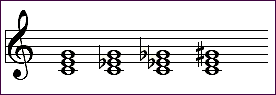
Notice what's actually changing: only the third and the fifth. Same root, same three notes, but shrinking or stretching those two inner intervals completely transforms the emotion. This is the single most important structural fact in harmony, and it's also the key to hearing chords: your ear, once trained, locks onto the third first. Is it major or minor? That one question already cuts the possibilities in half.
Practical starting point: sit at a keyboard (or use your instrument's equivalent) and play C major, then C minor, back and forth, listening hard to the third each time. The theory takes five minutes to read and a lifetime to internalize, and every minute spent distinguishing these two feelings by ear is worth it.
Seventh chords: the next shelf up
Add one more third on top of a triad and you get a seventh chord: four notes, more color, more tension, more sophistication. Sevenths are where pop meets jazz and where harmony gets spicy. The most common types:
- Dominant 7 (C-E-G-B♭): a major triad with a minor 7th. This is the workhorse of tension: the chord that pulls hardest toward resolution. Blues, boogie-woogie, and every V chord in jazz.
- Minor 7 (C-E♭-G-B♭): a minor triad with a minor 7th. Mellow, smooth, cool. The sound of soul, bossa nova, and neo-soul.
- Half diminished (m7♭5) (C-E♭-G♭-B♭): a diminished triad with a minor 7th. Anxious but functional: the classic ii chord in a minor key jazz progression.
- Diminished 7 (C-E♭-G♭-B♭♭): a diminished triad with a diminished 7th. Maximum instability, the dramatic chord of horror transitions and classic suspense.
There are more triad-plus-seventh combinations than these: major 7ths (lush and dreamy), minor-major 7ths (noir and mysterious), and others. EarMaster's Activity Setup includes a full chord definition table where you can explore them all, and more importantly, train them by ear.
Why sevenths matter practically: triads tell you the mood; sevenths tell you the style. The same 12-bar blues played with plain triads sounds like a campfire song, and played with dominant 7ths sounds like a smoky club. Same progression, different shelf.
Chord extensions and the jazz horizon
The stacking doesn't have to stop at four notes. Add more thirds and you reach the extensions: 9ths, 11ths, and 13ths. C-E-G-B-D-F-A, the whole stack, is a thirteenth chord, and jazz pianists use these giant harmonies constantly, usually trimming notes for playability and voicing.
You don't need to memorize the whole zoo today. But knowing the principle, keep stacking thirds, name the chord by its top interval, gives you a mental map of harmony that stretches from folk triads to the densest bebop piano. And it explains a mystery beginners run into: why "F major" and "D minor 7" sometimes seem to contain the same notes and serve similar functions. They often do: they're different windows onto the same stack.
Inversions: same chord, different personality
Until now we've described chords in root position: root at the bottom (C on the bottom of C major). But music rarely sits in root position all day. Rearranged versions of the same notes are called inversions:
- Root position: C-E-G (C on the bottom). Solid, grounded, definitive.
- First inversion: E-G-C (the third on the bottom). Lighter, floating, less final.
- Second inversion: G-C-E (the fifth on the bottom). Suspended, transitional, unstable.
On the staff below, the C major chord is shown in root position, 1st inversion and 2nd inversion:
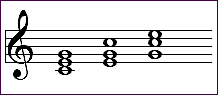
Here's the practical magic: an inversion changes almost nothing about the chord's identity (it's still a C major) but changes a lot about how it feels in the moment. Root position feels like a full stop; first inversion feels like a continuation; second inversion leans forward, waiting to move.
This matters most in voice leading and bass lines: a bass player walking D-E-F-G underneath a melody isn't playing four different chords, often they're playing four inversions of the same chord with a moving bass. And songwriters use inversions to smooth the joins between sections: the same four-chord loop, played with smart inversions, sounds far more polished and professional than the same loop thudded in root position.
Try this: play C-F-G-C in root position, then again with all inversions chosen so that the top notes barely move. The second version will sound noticeably smoother and more "produced," and you'll have heard exactly what inversions are for.
Hearing chords: putting the theory in your ears
Everything above is only half the skill. The other half is recognition on the fly: a chord plays, and you know what it is without looking. Practical tips for building that:
1. Start with the major/minor question. Don't try to identify everything at once. For your first weeks, the only question is "major or minor?" This binary alone makes you a functional jam-session musician, since most songs can be followed with this skill alone.
2. Then add the tense ones. Once the binary feels easy, add diminished and augmented, then the sevenths. Learn them as personalities, not formulas: dominant 7 is the "needs to resolve" feeling, minor 7 is the "smooth and cool" feeling.
3. Sing the chord tones. Play a chord, then sing from the root up: root, third, fifth. Singing chord tones internally is the foundation of hearing them clearly, and it doubles as sight-singing practice.
4. Use functional context, not just isolated drills. Chords are easier to identify in their natural habitat. A diminished chord followed by resolution is far easier to name than a diminished chord floating in silence. Train both, but prioritize musical context.
5. Train with instant feedback. As always, the loop is what builds the skill: hear, guess, check, repeat. EarMaster's General Workshops and the Jazz Workshops include chord identification exercises covering the full chord definition table, from basic triads to sevenths and beyond, and the app tells you immediately whether your answer was right, adapting to drill the qualities you keep confusing. Ten focused minutes daily beats hours of passive listening, and it directly trains the two fastest shortcuts: major-or-minor first, quality second.
6. Confirm in real music. Sit with songs you love and hunt for chords: find the home chord, then figure out whether the chord on the third bar is major or minor, then whether it has a seventh in it. Real music, real answers, and it cements everything from the exercises.
The bottom line
Chords are layers of sound, usually stacks of thirds, defined by root, quality, and inversion. Triads give you the four basic emotional colors; sevenths add tension and style; extensions open the jazz horizon; and inversions let you control how strongly each chord lands without changing what it is.
Learn them in that order, and pair the theory with feedback-based ear training in EarMaster at every step. The day you can hear a chord and instantly feel whether it's major, minor, tense, or lush, music stops being a foreign language you read slowly and starts being one you speak.


